Building Capacity for Agrivoltaics: Insights from Türkiye and Germany
As the effects of climate change intensify, the question of how to use land efficiently—for both food and energy—has become more urgent. Agrivoltaics - or agri-PV - the dual use of agricultural land for crop production and solar energy generation, is increasingly seen as a powerful response to this challenge.
The capacity-building workshop on “The Implementation and Expansion of Agrivoltaics in Türkiye and Germany”, organised by the Turkish-German Energy Partnership on 23rd October, gathered 50 participants from ministries, research institutions, associations and companies to explore how this dual-use approach can take root in both countries.
Türkiye: Building Momentum Amid Challenges
Özge Özeke (Oculus Insights) outlined Türkiye’s growing solar capacity and the increasing strain of climate change on agriculture. While the renewable sector continues to expand, legal and regulatory clarity for agrivoltaic installations remains limited. Farmers often face uncertainty about how the systems might affect soil or crop yields, and the relatively high cost of agri-PV systems adds to the challenge.
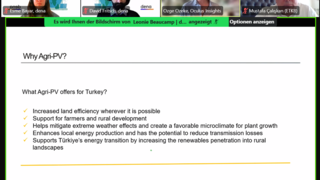
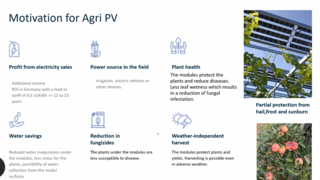
Nevertheless, the potential benefits — improved land-use efficiency, additional income for farmers, protection from extreme weather and accelerated progress toward Türkiye’s renewable targets — make agrivoltaics a promising avenue for future growth.
Germany: From Policy to Practice
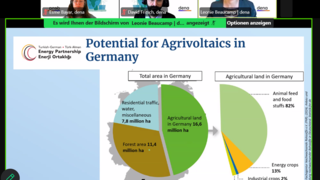
Leonie Beaucamp (German Energy Agency, (dena)) elaborated on the great potential for electricity generation through agrivoltaic systems across Germany while keeping farmland in productive use.
To help realise this potential, Germany is currently refining national standards to make it easier for farmers and developers to plan and install new systems. Simplifying regulation is seen as a crucial step towards turning pilot projects into mainstream practice. Financing, however, remains a sticking point — particularly if dedicated EU support for agri-PV projects is delayed.
Practical Lessons from the Field
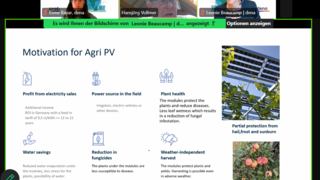
Drawing on his experience at Intech Clean Energy GmbH, Hansjörg Vollmer demonstrated how agrivoltaic systems can be designed in close collaboration with farmers to protect crops and even improve yields. His projects — spanning orchards, vineyards and berry farms — show how renewable energy can be woven directly into the landscape.
Shared Challenges and Pathways Forward
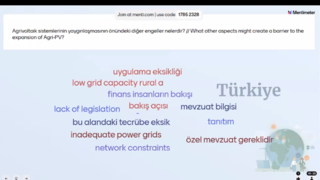
The discussions focused on identifying barriers and designing solutions for both countries. Participants emphasised that the main obstacles are financing, regulatory uncertainty and grid limitations.
Four priority measures were identified to advance agrivoltaics in both Türkiye and Germany
- Expanding grid capacity
- Establishing dedicated financing instruments
- Clarifying legal frameworks and land-use rules
- Launching pilot projects to build practical experience
- In his concluding remarks, Mustafa Çalışkan, Co-Chair of the TGEP Working Group on Renewable Energies, Energy Infrastructure and Sector Coupling and Head of the Department Renewable Energy & New Technologies at the Republic of Türkiye Ministry of Energy and Natural Resources (MENR) stressed the importance of enabling farms to use the electricity they generate, turning agrivoltaic systems into both a sustainable and economically viable solution.
The workshop brought into focus a shared conviction: Agrivoltaics is not simply a technology, but a new way of thinking about land, resilience and cooperation. For Türkiye and Germany alike, it represents a pathway toward a more sustainable and climate-resilient energy future.